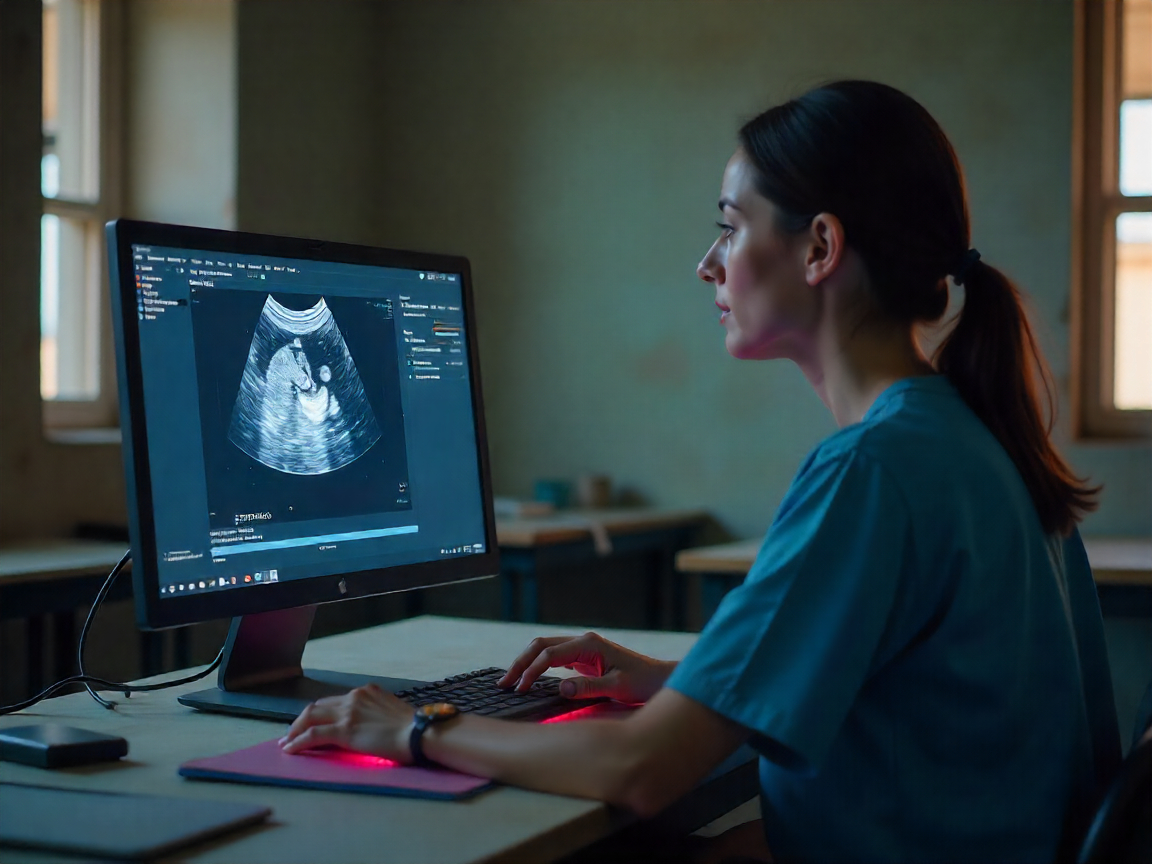
Just imagine walking into a rustic clinic in sub-Saharan Africa where diagnostic facilities are scarce, internet connectivity is undependable and radiologist nowhere to be found. Try now to imagine the situation when you urgently need an MRI scan to check on a possible tumor, but the algorithms capable of reading it require thousands of labeled examples to function. This is the truth when it comes to millions of people in the underserved areas. AI has enormous potential in medical application, but its insatiable appetite for huge, labeled datasets keeps its potential out of reach to most of the planet.
This is where the newest innovation of UC San Diego comes in. Scientists at the university have developed an AI system to segment and interpret medical scans that require little data in order to perform well. This tool works well with less than 100 images unlike the conventional models which require thousands of well labeled images. It is an engineering marvel, but it is also the opportunity to change the way things are currently being done across the world as far as health is concerned.
The Engine Behind the Breakthrough: Lean, Mean, and Smarter Than Expected
The technology that drives the UC San Diego model is also simple in its simplicity and extreme in its vision. It is basically a combination of transfer learning, self-supervised learning, and domain adaptation where it is teaching itself how to process new scans even in the case where the information is limited. The tool, with such a small set of annotated images, reached an 88.6 percent segmentation accuracy rate on unlabeled data, at least according to published results in the journal Nature Machine Intelligence by the lab.
This is done via methods such as synthetic noise injection, contrastive representation learning, and contextual reinforcement amongst others, and can thus infer visual trends without requiring a lot of radiologist feedback. It is like creating a novice doctor and giving him or her very few cases to work on yet he or she iselijk treating now a professional in that field.
From Silicon Valley to Nairobi: Where the AI Is Already Saving Lives
The real world applications are already in process. Deployed in two rural diagnostic laboratories in Kisumu and Eldoret, it is a pilot program run in collaboration with the Kenyan Ministry of Health and the AI for Health Initiative of the WHO. In the first six months, clinics have shown a 41 percent jump in early detection rate of breast cancer, when compared to their earlier manual review system. Remarkably, the AI model worked across scan modalities, and in low-resolution ultrasound to old CT scanners, further prompting it to be used in resource-constrained settings.
Case Study in Focus:
- Location: Eldoret Regional Hospital, Kenya
- Before AI: the average time lag in diagnosis: 9 days
- Post AI Integration: Reduction of delay down to below 36 hours
- Accuracy Gain of Tracking: 28 percent quicker recognition of the inner boundary of tumor (especially the dense tissue chest)
As one of the doctors Dr. Faith Omondi said, “We did not have the luxury of time or data.” This instrument does not only help us, but it helps increase our capacity.”
Expert Insight: “This Redefines Access in Medical AI”
The innovation was applauded by Dr. Ravi Patel, an AI diagnostics researcher at Stanford, who made a comment on it in an interview with MedTech Africa. This turns the story upside down. The past few years have been spent in pursuit of larger data and showier models. However, this is a knife that makes it leaner and performs better than others. So, this is democratization at work.”
Such a feeling reflects a liberal trend in AI ethics and design: creating less-bloated, flexible, and locally deployable solutions, and not simply promoting mega-models built in centralized facilities. As a matter of fact, the team at UCSD is planning to open-source parts of their design to academic use in Q4 2025, which is a remarkably open practice in the highly competitive arena that also houses exclusive labs.
More Than a Tool—A Moral Imperative
The truth is, AI would further introduce a type of digital healthcare inequality until it stops being a privilege only accessible in the most well-endowed hospitals. However, this UC San Diego breakthrough is not only technically impressive, but it is morally urgent. It is a template that evens out the playing field without even out the budget.
What would happen if the future of the healthcare AI is possessed by not the largest, but the brightest? The ones that understand not just images—but context. The ones built not just for performance—but for people.
This might be, just might, be the blueprint we have been waiting for, data-sparse imaging AI.