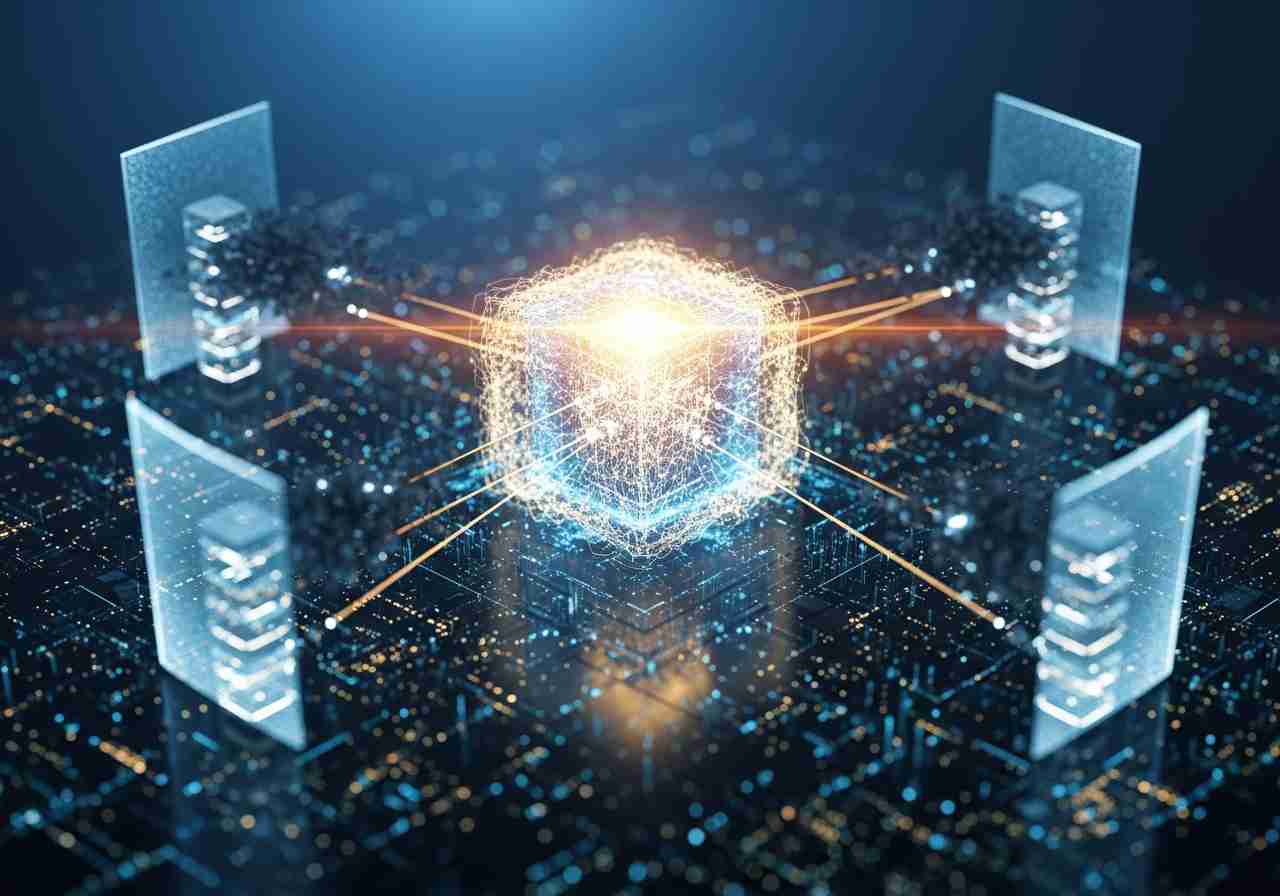
Consider the available cybersecurity tools. They are a security guard like a genius who is overworked. The list of known threats with them is enormous. However, they have not seen the office layout and are unaware of your team’s habits. They react purely on instinct. Suppose now a system that is not simply guarding the door. It is inside your virtual walls and knows the pulse of your business. It is what AI-Native Cybersecurity promises. It’s not just an upgrade. It is an entire architectural revolution.
Lots of AI features have been pinned to older security systems over years. We referred to it as next-gen and wished it was so. The conclusions were usually awkward. However, the actual transformation is the establishment of security with artificial intelligence as its fundamental structure, intelligent nervous system. This is not of including a smarter alarm. It is about building a living and dynamic immune system to your whole digital body.
Beyond the Algorithm: What is really AI-Native?
But what then is the difference? Machine learning can be used in a traditional system to identify a known virus signature. An AI-Native platform, though, is built in a different way, based on it. It is not actually a code-running operating system, but a platform that supports intelligent and autonomous agents. These agents work with each other in real-time. They understand your normal. Subsequently, they protect it aggressively.
This design is based on a feedback loop. Information infiltrates at all sides of the IT environment. This data is analyzed by an agent called orchestrator. Thereafter, it sends professional agents to trace minor abnormalities. Network traffic analysis may be done by a single agent. The other is one that scrutinizes the behavior of the user. They don’t just report back. They share conversations thus creating a contextual narrative.
- The fundamental change lies in the fact that the rules are human-determined and instead discovered by AI.
- It is the distinction between a checklist and the sense of an experienced detective.
A Living Defense: The Mechanics of It
Let’s get concrete. How this actually works within the network of a company? The AI-Native system sets a dynamic baseline instead of waiting until there has been a breach. It gets to know that the accounting section constantly accesses the financial server during the period of 9 AM to 6 PM. It is aware of their average scale of transferred data. At 2 AM, suddenly, there is an attempt at a download of massive data by a different device with stolen credentials.
This may be lacking in a legacy system. The qualifications were legitimate, anyway. The AI-Native system however regards the whole situation as un-right. The time, the behavior, the size of data. The device can be instantly isolated by an autonomous agent. It may then activate a countermeasure agent to limit the threat. All this is done in milliseconds, and a human being does not have to push a button.
Think of the 2023 MGM Resorts hack. Social engineering was conducted in a basic form by attackers to circumvent helpdesk controls. A rule-based system was powerless as a legacy. However, an AI-Native defense would have been monitoring the next actions of the attacker. It would have detected the lateral aberrant motion. The weird spike in access requests. Behavioral circumstances might have raised a red flag and indicated the whole session as hostile and prevented the attack before it crippled the company.
The Human Factor: Adding, Not Replacing, Your Team
Here is the question now; does it render my security team redundant? Absolutely not. The goal is augmentation. Imagine that you are giving superpower to your analysts. The exhausting, high volume alert triage is done by these AI agents. This liberates your human professionals. They are then able to pay attention to strategic threat hunting and sophisticated incident response.
The system does not simply state that there is an anomaly detected. It provides a curated report that explains the ‘why,’ connecting the dots between events that appear to have nothing in common. This changes the role of security team to that of a strategic architect rather than a fire fighter.They are the ones who guide the AI and refine its goals. Their judgments are subtle and need to be made by human hands.
- The most effective results are combinations of machine velocity and human instincts.
- Your group ceases to pursue notifications and begins to triumph the war.
The Unavoidable Obstacles: Cost, Complexity and Trust
Admit it, it is not a silver bullet. Ai-Native future is coming with a great deal of challenges. The calculation cost is enormous. The backbone of IT would require a strong and costly training and running of these advanced models. Moreover, the complexity of integration is a nightmare. The integration of this new smart core into a tapestry of current systems is an uphill endeavor.
Trust is, perhaps, the greatest obstacle. Is it possible to rely on black box to make critical security decisions? The issue of explainability does exist. Security leaders should know the motivation behind the action of the AI. Lack of transparency will put a halt to adoption. We are requesting organizations to place their all-digital safety on a shaky system.
The Future is Proactive: New Security Paradigm
The evolution is clear. We are shifting towards a proactive rather than a reactive model of security. The former paradigm was a fortress that had firm walls. The new one is a living ecosystem which is accommodating to the terrain. It forecasts the origin of the attack. It reforms its defenses on a real-time basis.
The massive number and complexity of contemporary threats are fueling this change. It is not possible to scale fast using human teams alone. AI-Native cybersecurity is not a feature of the high-end market. It is soon becoming a necessity to any business that is serious about its IT resilience. It is not whether you are going to adopt it, but when.
Last Impression: It will not be the companies that have the highest security tools that will succeed in the future. They will also have the smartest security architecture. The competition is not on the height of the wall. It is to develop a more intelligent immune system. Is that your future you are building or do you just carry on the walls?