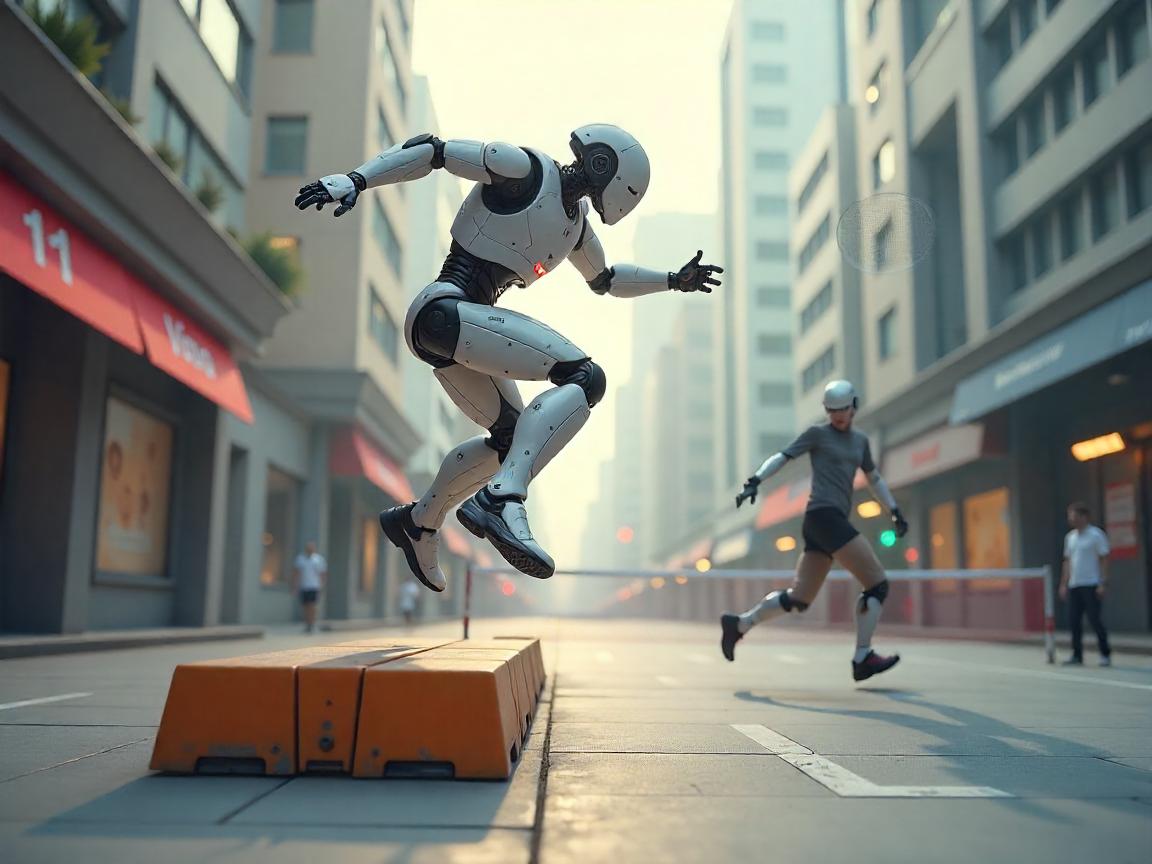
The world was astonished when Boston Dynamics Atlas somersaulted, waltzed and ran through obstacle courses. But it did not stop there. Modern robots are not just posing: they are also changing the meaning of the term machine agility, combining such activities as parkour and badminton under realistic conditions. What is driving this innovation? A combination of strategic planning, advanced control systems and split-second perception. Hang on-we are going into the revolution.
From Vaults to Victory: Parkour as the Ultimate Mobility Test
Parkour is not only show; parkour is the best way to check dynamic balance, reflexes, and the body intelligence. Robots such as Atlas have gone extensive past simple gymnastic routines, with the incorporation of whole-body dynamics:
- Atlas can easily skip over logs, climb platforms and rigorously keep up with the pace through embedded computer vision and body coordination
- In early 2025 videos, Atlas runs entire parkour circuits; skipping logs and doing cartwheels with almost human grace.
They are not choreographed performances: they are learning-based control loops founded on trial-and-error reinforcement learning. According to Boston Dynamics, it is training legged robots in high-fidelity simulations and then deploying the refined versions in the real world, which cuts down wear and tear by a huge margin. Reddit enthusiasts are abuzz:
Atlas can now: walk, run, crawl… both Figure & Atlas are deploying end-to-end neural networks, RL with sim training…
Mastery of parkour is not just a form of viral boasting rights, but a stepping stone to robust robots that can traverse disaster sites, uneven terrain or even day-to-day conditions with ease and without needing direct control.
Rallies and Returns: When Robots Play Sports
Obstacle courses, shuttle rallies, and other sports are welcoming robots:
- A Swiss–Korean team developed a quadruped robot–named Raibo–which uses neural network based mapping to traverse walls, staircases and surfaces
- The ANYmal-D robot, stereo vision and a manipulator limb, was able to withstand ten badminton shots in a row with humans.
The scholastic discoveries incorporate:
- Hybrid IL+RL control policy with 94.5 % success against a serve machine and 90.7 \ necessities vs human players
- The policies used in reinforcement learning that synchronizes locomotion and arm motions, addressing the issue of shuttlecock randomness
These breakthroughs bring together sensation, tactics and physical manipulation-robots are not merely in motion, they are in competition.
The Tech Behind the Triumph
What then are they doing to achieve it? Under the hood is this:
- Hybrid Frameworks: Integrating model-based locomotion cores with learning-driven manipulation arms – RL improve behaviors proposed by physics models to be stable .
- Event-Driven Perception: By using ultrahigh-speed cameras, the shuttlecock or shuttle speed can be detected with microsecond resolution-as can table-tennis bots .
- Shuttle Prediction Networks: Trajectory models are boosted by visual data feeds and systems of spatial attention follow objects in flight at 130+ fps
- Reinforcement Learning in Simulation: Zero-risk simulated training, followed by real-world optimization, results in fast learning of locomotion skills .
Expert Opinion: Is It Athleticism—or Engineering?
“We have spent decades to teach robots how to obey the rule- now we are teaching them how to creatively violate the rule.”
Dr. Hannah Moretti Robotics Professor ETH Zurich
The kind of thing that comes from having that embodied intuition, that Mid-jump recovery, that expecting a shuttlecock to curve, that is not just control theory, that is emergent intelligence. Naturally, the systems remain in their infancy; we should not speak about autonomy yet. In the meantime, it is simulation-initialized movements that are perfected with the help of supervised learning.
Case Study in Action: Real-World Performance
Suppose we magnify on an exemplary case:
- On a combined Swiss-Korean robotic test, Raibo dynamically responded to the irregularities of the terrain by wall running, vaulting, and climbing stairs with perceptual-mapping neural networks.
- At the same time, ANYmal-D demonstrated agility over a long period: precise shuttle predicting, robust positioning, and repeated returns in ten volleys.
These showrooms highlight a decisive breakthrough: Robots that physically improve to unknown conditions in the real world, and not only pre-programmed demonstrations.
Looking Ahead: Redefining Robotics & Athletics
What can we infer of this fast evolution?
- Real world preparedness: Parkour training is equivalent to disaster relief preparedness; sport training is equivalent to fine manipulation.
- Ethical meeting points: Like in athleticism, should sport federations adopt robotic leagues as robots become athletic?
- Human Robot synergy: Athlete robots would facilitate training of the future athletes, physical therapies or even assist in far-off rescues.
Final Takeaway: Time for New Arenas?
It is exciting and creepy to see a robot grinding like a professional gymnast. We are seeing mechanical bodies and artificial intelligence minds pave their way into physical areas that used to be considered distinctly human.
My two cents: we are quickly entering the age of the merger between sports, engineering and entertainment. Think of robotic triathlon, parkour competitions, or badminton tournaments. Not next year–but in ten years. What do you think? Shall we construct stadiums to circuits of electric athleticism, or maintain physical space as a human only competitive arena?