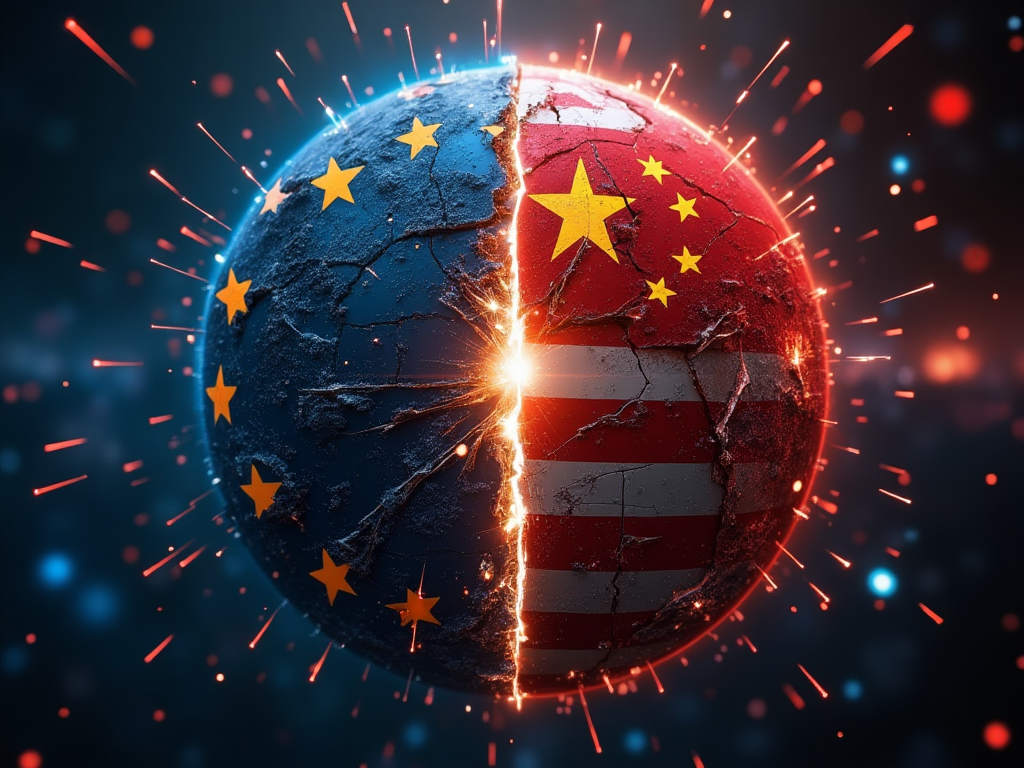
The Internet Was Never Meant to Have Borders—Until Now
Remember when the web felt like a global village? Those days are fading fast. The digital world is a territory now being divided by nations, who insist that the big techs like Google, Meta, and Alibaba must store data domestically and AI must not get out of their hands. The EU imposes billion dollar penalties on data leaks, China keeps foreign AI out of the country completely, and the U.S. is banning apps like TikTok in the name of homegrown chips at the cost of billions of dollars. It is not only regulation but it is an all out digital sovereignty war and the implications of the fallout can break the internet as we know it.
Why Governments Are Demanding Control Over Data and AI
The shift isn’t happening in a vacuum. It is being propelled by three forces which are security, economics and brute force. Since the leaks of the NSA by Snowden, the EU no longer trusted U.S. data handling. China, fearing Western influence, built its own censored web. And now, AI has been purely a gas to the fire men have better control of the data, they have better control of the algorithms and whoever holds the algorithms owns the future.
An example is EU GDPR, which compelled Meta to cease data transfer to the U.S. or be fined as much as 1.2 billion euro. Or the 2021 Data Security Law in China, requiring that all the driving records of Tesla and all the user profiles of TikTok remain on Chinese soil. Even a traditionally open-tech powerhouse such as the U.S. is showing muscles, with the CHIPS Act and associated threats to ban TikTok unless it stops doing business with Beijing.
Case Study: How Apple Plays Both Sides—And Why It’s Struggling
Few companies embody this tension like Apple. In China, it keeps keys to iCloud on servers operated by a state-owned telecommunications company, a compromise that privacy advocates term as dangerous. In Europe, Apple is once again opposing the campaign by the EU to open its App Store under the pretext of security concerns. It is a manifest contradiction: How can a universal tech corporation be under and serve masters with cross demands? The answer, at the moment, is a wobbly kind of. The precarious dance of Apple is indicative of how the deepest-pocketed companies are also participants on the stage of digital divestment.
The Hidden Cost: Startups and the Splinternet Effect
The smaller players are being squashed with giants like Microsoft and Google building local data centers in order to comply. When one Berlin-based AI startup recently told Wired that both EU compliance costs were cutting into its funding round by 30 percent, it is not hard to imagine the implications of compliance being the difference between a cash-strapped startup and one that succeeds. In the meantime, India and Brazil are coming up with their own data laws, which means that every country may have its own laws in future. According to Gartner, by 2025, 75 percent of global data will be subject to localization policies, which is a nightmare of innovation. Can you imagine all the traffic rules to be different by road in Europe? That’s where we’re headed with data.
Expert Insight: “This Isn’t Regulation—It’s a Tech Cold War”
The European Union, China and the U.S. all have different motives of oversight, isolation, and domination, respectively, according to Dr. Laura DeNardis, the leading expert in the field of internet governance. “We’re not just talking privacy anymore. This is concerning who dictates the rule of economy of the coming century.” The trouble is that, unless the international community can strike a compromise, we may just get a splinternet, a system where data, applications, and even artificial intelligence models cannot move across borders.
What Comes Next? Three Possible Futures
- The Balkanized Web: Countries are ghettoizing their online environments, murdering the world wide web.
- The Uncomfortable Cease-Fire: Giant tech corporations strike bargains to share information with close monitoring (image of a digital NATO).
- The Wild Card: AI is faster than the laws and can produce loopholes, making sovereignty battles outdated.
Final Take: The Internet’s Golden Age Is Over—What’s Your Move?
Borders on the web are becoming a reality. The question is whether that is good or bad depending on whom you ask. A privacy advocate might cheer Europe’s GDPR. A free-speech activist would rage at China’s firewall. However, there is one fact that cannot be denied: the tech giants can no longer dictate the terms they order to be followed; that role belongs to governments. The question isn’t whether digital sovereignty will reshape tech. It is whether it is going to split the internet irreparably or not.
So where do you stand? Do the companies fight, evolve, or lobby with the new world standards? Hit reply—I read every response.