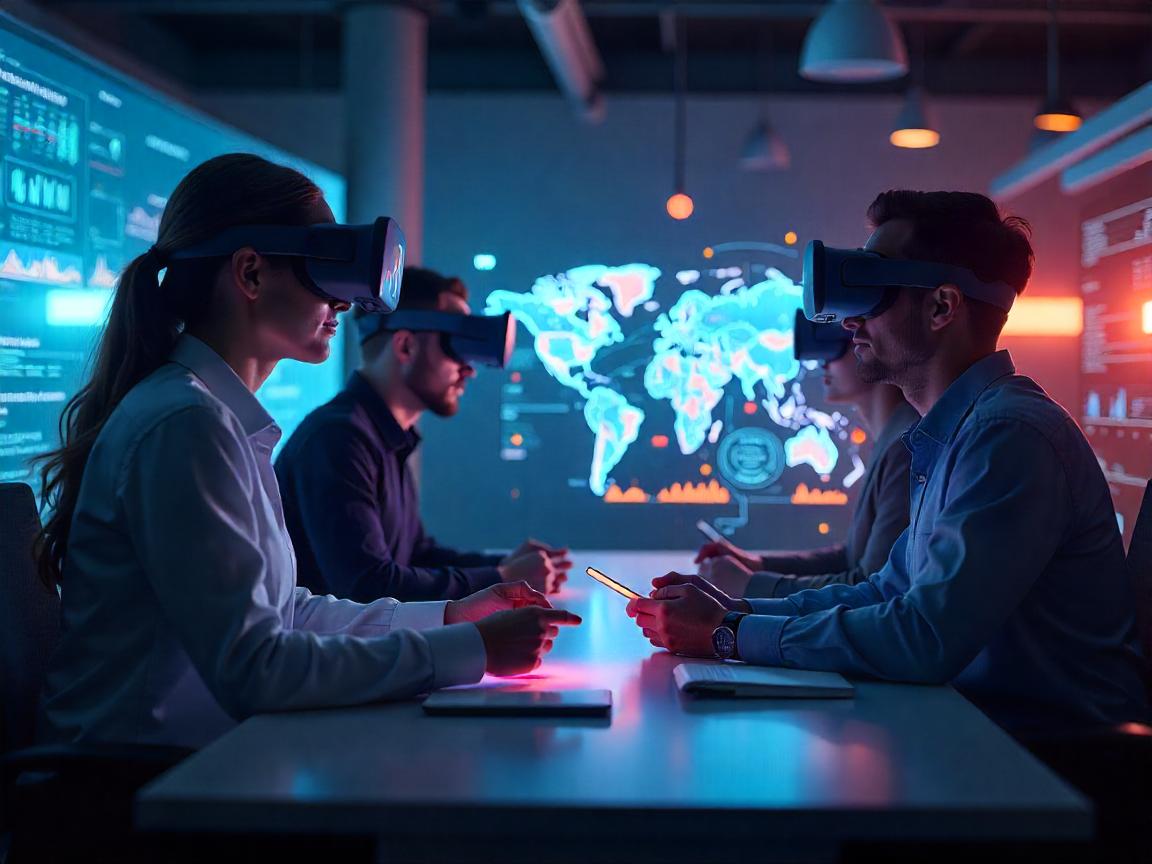
Mixed Reality Devices in Enterprise Applications: A Business Revolution in 2025
Consider this: You enter a room, and you connect a smooth headset and, within a few seconds, you are on a full-scale virtual factory floor, with real machines and you are carrying out simulations and you are talking to other team members who are miles away miles away physically. Sounds futuristic? Not anymore. Mixed Reality (MR) devices which combine Augmented Reality (AR), Virtual Reality (VR) are no longer experimental novelties. By 2025, they are solemn tools of business transforming the way businesses train, collaborate as well as serve customers.
The enterprise use of MR has evolved beyond more pilot tests into the boardroom, due to the combination of falling prices of devices, the changing infrastructure of 5G, and the demand of more immersive digital experiences after COVID. However, what really drives this wave is not only the technology–it is the looming human demand to be more involved, learn more quicker, and dwell more significant interactions with all things digital.
Immersive Training: A Shortcut to Mastery
Conventional training system is finding it hard to keep pace with the current rate of innovation. Memorization of manuals, video tutorials, and classroom sessions are simply not enough to raise personnel in the form of technicians and operators who can come up with precise high-stakes work.
Consider, e.g Boeing. They have also reduced training time by almost 30 per cent, first-time precision through use of AR glasses to train technicians. Consider the idea of getting taught how to wire an aircraft without the physical interaction of such–but just using visual clues that are placed on top of actual items. Not surprisingly, a recent study of workforce by PwC determined that in the VR-trained workforce, the employees were 275 percent more confident in transferring their skills than in the case of instilled-in-the-classroom employees. Doing it in a place that people had never done it before? They were four times quicker to learn.
The other industries are acquiring it:
- Black Friday training modules based on virtual reality have become a raging success that Walmart is using to train over a million employees each year to work in chaotic sales momentums.
- Innovative work on how AR can be used to teach Lab technicians work safely with volatile chemicals without wasting one single vial.
- Siemens applies MR such that engineers can create real-time, virtual schematics to work with, which decreases fieldwork errors, and expense.
These are not experiments to do once.They are structural changes- companies spending on a simulated learning experience that is reality-like, boosts retention skills and has no geographical limitations.
Virtual Collaboration That Feels Tangible
Having organized several cross-border projects in the two past years, I can say first-hand: Zoom fatigue is real. And even when we do it to the best of our capabilities, remote collaboration cannot be quite as multi-faceted as the face-to-face meetings. Out come MR collaboration platforms.
The most well-known name is Microsoft Mesh perhaps. It allows professionals to be in holographic workspaces and connect to work with 3D models, digital whiteboard, and most important of all, other humans even though they are physically distant. Accenture is fully in: more than 150,000 staff have joined the company through its own tailor-made VR campus, named The Nth Floor, which is an all-time virtual office radioing all sorts of activities, including strategy sessions or even wine happy hours.
Mixed reality collaboration goes beyond covering physical geography. It advances the manner in which thoughts are communicated:
- Engineers improvise on the product models collectively in 3D before producing one part.
- Such storyboards of the AR can be co-created by the global marketing teams and then be put to direct test in the real environments.
- The most immersive use of interviews and interactive skill testing occur with the HR departments where a deeper picture of the candidate abilities is given.
The experiences are not just convenient, as they are productive, creative, and in most cases, even more effective than the physical meetings.
Customer Experience That Sticks
We should not forget about the customer. When you hear MR, you may perceive it only refers to internal operations but you are wrong. The consumer-facing aspect of MR is taking off-companies are spending big to make it more engrossing, personal, and experiential.
Such is the case of Audi. They have virtual showrooms where the customers can view car models in the virtual reality type of environment. Audi is claiming these experiences led to a 20 percent improvement in customer retention duration, and 18 percent growth of upsells of presenting personalized configurations on-demand. In the meantime, Shopify merchants that used AR product views gained a 94 percent conversion rate that is higher than the use of stagnant images.
I have witnessed brands in the fashion industry, real-estate business, and even in pet care adapt AR filters and 3D-trys on. There is one real estate company in Dubai which currently provides the most real estate experience: clients visit virtual penthouses and enjoy views available on a balcony without a plane. It’s smart. It’s scalable. And it is tacky.
Expert Insight: Culture Over Code
This is where a lot of companies fall. Technology is not the largest obstacle, yet adoption. And that, in turn, which Saanvi Kulkarni, the CTO of SimulTech Inc. brusquely put it at this year WebXR Summit, is the greatest challenge of MR adoption, which lies in the managers putting their 2D thinking aside.
She’s right. The legacy systems to immersive systems migration needs:
- Changes management techniques that deal with user resistance.
- Ergonomic factors (headsets will tire the novice).
- MR developers of storytelling, who are aware of enterprise storytelling.
Organizations that achieve success in the presence of MR tend to put great investments not only in devices but also in establishing the culture of immersive thought-not only during onboarding but also among leaders.
Final Thought: MR Isn’t a Gadget—It’s a Growth Strategy
This is the one thing that needs to be taken out of this: it is not a passing fad, and not a toy to be played with by tech-savvy companies, mixed reality. It represents a paradigm change in terms of interaction, learning, and selling of digital economy. Companies who choose not to focus on MR today will be struggling to keep up tomorrow, not only in technology, but personnel, productivity and consumer loyalty.
Therefore, it is not the question of whether we should investigate MR.
It is, Why can we pilot, learn, and scale it, faster than our competition does? The age of mixed reality is staring us in the face and it is not waiting.